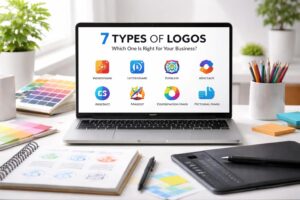
Not All Logos Are Created Equal
When most people think of a logo, they picture a simple symbol or a stylised company name. But logo design is actually a broad discipline with distinct categories, each with its own strengths, ideal use cases, and psychological effects. Choosing the right type of logo for your business is one of the most important early branding decisions you will make.
Here is a clear breakdown of all seven logo types, what they do well, and which businesses they tend to suit best.
1. Wordmark (Logotype)
A wordmark is a logo built entirely from text — specifically the brand name, rendered in a distinctive font or lettering style. Google, Coca-Cola, and FedEx are all wordmarks. There is no symbol involved; the name itself becomes the identity.
Wordmarks work exceptionally well for businesses with short, distinctive names. They build direct name recognition and are highly versatile across formats. If your business name is unique, memorable, and easy to read, a wordmark could be your strongest option.
2. Lettermark (Monogram)
A lettermark uses initials or abbreviations rather than the full company name. IBM, NASA, and HBO are classic examples. This works well when a business name is long, complex, or difficult to abbreviate visually in logo form.
Lettermarks require careful typography work. The individual letters must work together as a cohesive unit and remain readable even at very small sizes. They can become extremely powerful once the brand is established.
3. Pictorial Mark (Symbol)
A pictorial mark is a standalone graphic — an icon that represents the brand without the company name. Apple’s apple, Twitter’s bird, and Target’s bullseye are all pictorial marks. They are the holy grail of brand recognition, but they work best for brands that already have significant recognition or an icon closely tied to their name.
4. Abstract Logo Mark
Similar to a pictorial mark but without a literal image, abstract logos use geometric shapes and forms to convey meaning. Nike’s swoosh and Pepsi’s circle are abstract marks. They are powerful because they carry no preconceived meaning — they are entirely owned by the brand.
Abstract marks are ideal for businesses operating across multiple industries or international markets where literal imagery might carry different cultural connotations.
5. Mascot Logo
A mascot is an illustrated character that represents the brand — often a person, animal, or creature with a distinct personality. KFC’s Colonel Sanders and Michelin’s Bibendum are globally recognised mascots.
Mascot logos are particularly effective for brands that want to build a friendly, approachable, or playful identity. They are excellent for food businesses, children’s brands, sports teams, and any business where personality and relatability are key selling points.
6. Combination Mark
A combination mark pairs a wordmark or lettermark with a symbol, icon, or mascot. Adidas, Burger King, and Lacoste all use combination marks. This is the most flexible logo type because the elements can be used together or independently as the situation demands.
Combination marks are often the best starting point for new businesses because they build symbol recognition while keeping the name visible for early brand awareness.
7. Emblem
An emblem contains text inside or closely integrated with a symbol or badge — like the logos of universities, government bodies, and heritage brands. Harley-Davidson and Harvard University both use emblems.
Emblems convey tradition, authority, and prestige. They are ideal for schools, legal firms, luxury brands, and any business where heritage and credibility are central to the brand story. The main consideration is scalability — intricate emblems can lose detail at smaller sizes.
So Which One Is Right for You?
The right logo type depends on several factors: the length and distinctiveness of your name, the industry you are in, the audience you are speaking to, and the personality you want your brand to project. A great designer will walk you through these considerations before a single concept is sketched.
At The Logo Wolf, we begin every project with a thorough brand discovery conversation. Understanding your business deeply is what allows us to recommend — and then build — the right type of logo, not just the one that looks good on a screen.
Ready to elevate your brand?
Get in touch with The Logo Wolf today at thelogowolf.com and let’s build something unforgettable together.